
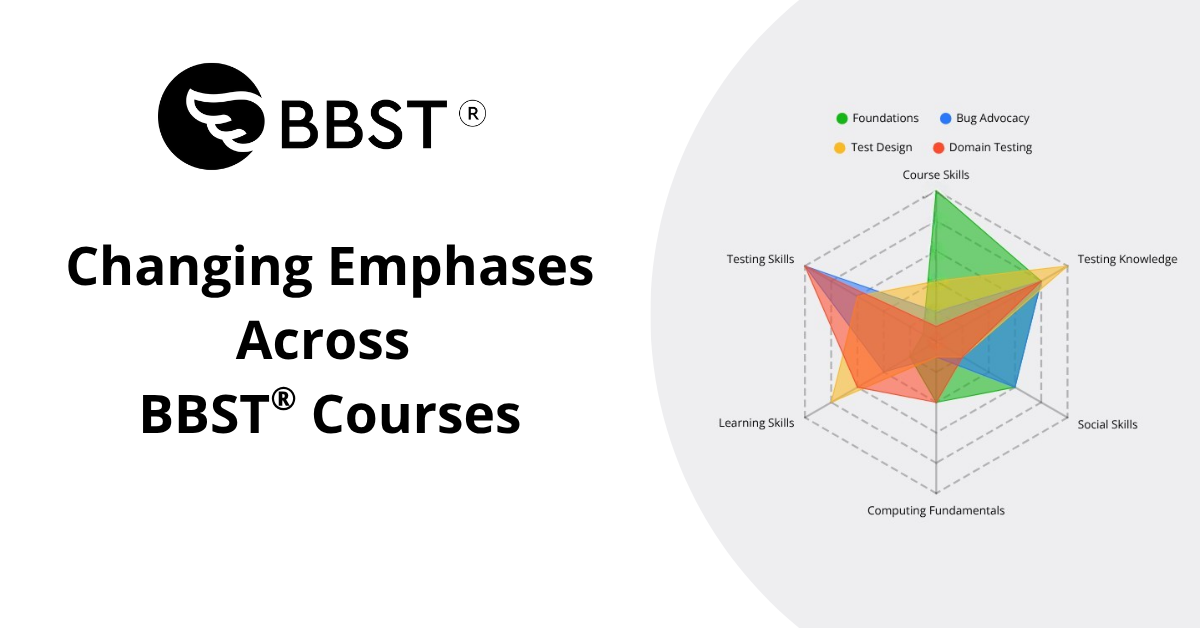
In this video, I describe how the emphases shift from one BBST® course to another. Each course in the series focuses on a specific combination of knowledge and skills, depending on where the student is in the learning process and the course’s learning objectives.

For example, BBST® Foundations, being the first course in the series, emphasizes helping participants acquire the skills needed to successfully complete BBST® courses. In addition, it establishes a common baseline for understanding key software testing concepts before moving on to more advanced topics. That’s why the second major focus is on testing knowledge.

Key takeaways

  • Each BBST® course puts a different weight on six areas: course participation skills, testing knowledge, testing skills, learning skills, social skills and computing fundamentals.
  • BBST® Foundations puts course participation skills and testing knowledge first. It prepares you for the BBST® learning model and builds a shared baseline of core testing concepts.
  • In BBST® Bug Advocacy, testing skills rise sharply while testing knowledge stays high. You investigate and report bugs in a real-world application, using the RIMGEN framework.
  • BBST® Test Design is a survey of around 75 test techniques. Testing knowledge, testing skills and learning skills all overtake course participation skills.
  • Social skills and computing fundamentals matter most in Foundations and get less attention in later courses.

Watch the video below to learn more about how the focus evolves across the BBST® courses.

In this video, I’ll explain what each BBST® course focuses on, and how the learning objectives shift as we move from one course to the next.

Let’s start with Foundations.

At the top of Foundations’ focus are course participation skills.

Since Foundations is the first course in the BBST® series, one of our key goals is to help participants adapt to online learning and get comfortable with the BBST® model. That includes understanding the course structure — video lectures, quizzes, assignments, the exam — as well as the pacing, with biweekly deadlines that keep everyone moving together.

It also means getting used to the teaching style: instructor feedback, peer reviews, and the grading standard. An instructor doesn’t simply grade assignments. They coach improvement and hold students accountable for the quality of their work.

Being the Foundations course, testing knowledge is equally central.

We explore core testing concepts — defining, explaining, comparing, and contrasting them, analysing and even building pro-and-con arguments — to reach a deep, conceptual understanding.

Research shows that many students struggle to maintain motivation in online settings where the sense of connection and peer interaction typical of a physical classroom is missing. That’s why social skills play a significant role in Foundations. Classes are small (maximum 25 people), designed to encourage interaction and collaboration, and some assignments explicitly require it.

Computing fundamentals has a separate lesson in this course.

While some participants already have a computing background, this is a good opportunity for all to refresh or to learn the basics.

A tester’s credibility and professional standing depend on understanding how software works, which is why this topic is part of the Foundations focus.

And then there are learning skills, the broader abilities that help students not just complete a course, but become lifelong learners.

Finally, while Foundations provides the context and structure to acquire the skills needed for all BBST® courses, it doesn’t leave out the testing skills testers need in their professional work, even if these are not the main focus yet.

When we move into Bug Advocacy, testing skills rise sharply in importance.

Students now work on a real-world application and engage in more hands-on assignments learning to create attention-grabbing summaries and to thoroughly investigate and describe bugs using the RIMGEN framework.

Testing knowledge focus remains high. We continue to deepen understanding of key concepts, both through reading and through practice.

Social skills still matter here. Participants are still developing routines for online learning and benefit from staying motivated and learning from peers, a core principle of adult learning.

Learning skills now move up in focus, surpassing course participation skills. Students begin applying what they’ve learned to more complex, realistic problems.

In Bug Advocacy, there’s less emphasis on computing fundamentals, as the attention shifts toward practical testing and persuasive communication about bugs.

Let’s take a look at the learning objectives that Test Design focuses on.

Test Design is a survey course, covering around 75 testing techniques. It aims at broadening software testing knowledge. Students encounter a wide range of methods and concepts, developing a broad understanding of how to approach the challenge of designing powerful tests.

Learning skills overtake course participation skills.

Students must understand, analyze, evaluate, and apply techniques efficiently — developing critical thinking and active learning abilities.

Test Design places meaningful emphasis on testing skills, with practical assignments involving real-world applications.

By this point, social skills play a smaller role — students are already familiar with BBST® collaboration norms — and computing fundamentals receive less attention.

That’s it for now. I’ll cover Domain Testing in a following video. I hope this gave you a clear picture of how the focus shifts from one BBST® course to the other.

BBST® Foundations: learning the BBST® model and core testing concepts

Foundations has two top priorities. The first is course participation skills: adapting to online learning, the course structure (video lectures, quizzes, assignments, exam), biweekly deadlines, and a teaching style built on instructor coaching, peer reviews and a clear grading standard. The second is testing knowledge: defining, comparing and building arguments about core testing concepts until you understand them in depth.

Small classes of at most 25 participants support the social skills that keep online learners motivated. A dedicated lesson covers computing fundamentals, because a tester’s credibility depends on understanding how software works.

BBST® Bug Advocacy: testing skills move to the front

In Bug Advocacy, the focus shifts to hands-on testing. Participants work on a real-world application, investigate bugs thoroughly, write attention-grabbing bug summaries and describe problems using the RIMGEN framework. Testing knowledge stays high, and social skills still support motivation and peer learning. Learning skills rise as students apply what they’ve learned to more complex, realistic problems, while computing fundamentals get less attention.

BBST® Test Design: breadth of techniques and critical thinking

Test Design is a survey course covering around 75 testing techniques. Its main goal is to broaden your testing knowledge. Learning skills move ahead of course participation skills: you need to understand, analyze, evaluate and apply techniques efficiently. Practical assignments on real-world applications keep testing skills important. Social skills and computing fundamentals play a smaller role, since participants already know how BBST® collaboration works.

What about BBST® Domain Testing?

Domain Testing will be covered in a separate video.

Why continue without a long break

After successfully completing Foundations, participants are encouraged to continue to the next course without extended breaks. Maintaining continuity allows the learning knowledge and abilities practiced in the first course to transfer more effectively into subsequent BBST® experiences.

That’s why we encourage participants to continue with a specialization path. Choosing a specialization provides a clear development goal and helps you get the most out of the BBST® learning experience.

Explore our BBST® specializations!

Share This Article!

About the Author: Oana Casapu

Subscribe to the BBST® Resource Center

One newsletter per month with relevant content.

We send our newsletters using Mailchimp. By subscribing, you acknowledge that your data will be transferred to Mailchimp for processing. Read Mailchimp's privacy practices here.